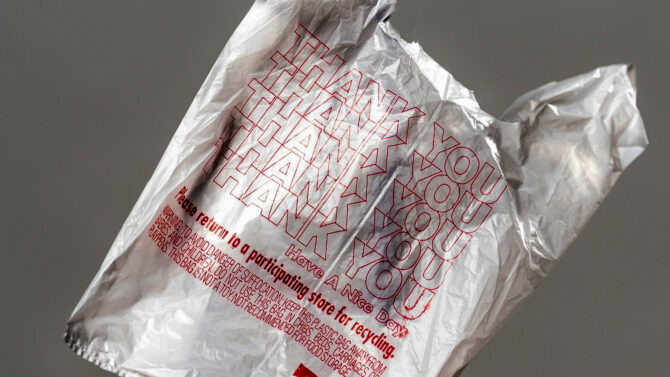
Last Friday, California Attorney General Rob Bonta announced a new front in the state’s ongoing battle against plastic pollution. The Attorney General filed suit against three of the nation’s largest plastic bag manufacturers, Novolex Holdings LLC, Inteplast Group Corp., and Mettler Packaging LLC, alleging that the companies falsely labeled carry out bags “recyclable” and “return to participating store for recycling,” .. despite that the bags are objectively “recyclable.”
At the same time, the Attorney General announced settlements with four other plastic bag producers, Revolution Sustainable Solutions LLC, Metro Poly Corp., PreZero US Packaging LLC, and Advance Polybag, Inc., resolving similar allegations. Under those settlements, found here, here, and here, which are subject to court approval, the companies agreed to halt plastic bag sales in California (what many have alleged is the aim here) and collectively pay $1.75 million, including $1.1 million in civil penalties and $636,000 in attorneys’ fees and costs.
A Broader Context: The Plastic Problem
California alleges that in the 1950s, the world produced about 1.5 million tons of plastic annually. Today, that figure exceeds 300 million tons, and it continues to rise despite decades of “recycling” messaging; the plastic recycling rate in the U.S. hovers around 6 percent. The other 94 percent is landfilled, incinerated, or released into the environment.
California’s Statewide Commission on Recycling Markets and Curbside Recycling has concluded that of the seven general categories of plastic, only three, all variations of plastic bottles, meet the legal definition of “recyclable” in California. Plastic film, including grocery bags, does not.
Plastic bags, in particular, pose unique harm. California says that less than 5 percent of single use plastic bags were actually recycled. The remainder clog sorting machines, shut down recycling equipment, and endanger workers. They block waterways, pollute ecosystems, and break down into microplastics that have now been found in drinking water, food, air, and even human lungs and breast milk.
California’s Legal Framework: SB 270
California’s SB 270, enacted in 2014 and effective since 2016, banned single use plastic carry out bags in major retail settings and allowed only thicker, reusable plastic film bags that meet stringent criteria. Among other things, those bags must:
- Contain at least 40 percent recycled content;
- Be capable of 125 uses while carrying a specified weight; and
- Be “recyclable in the state” meaning there must exist actual, functioning infrastructure and markets to process them.
The law also authorizes the Attorney General to enforce compliance and to penalize deceptive environmental marketing or mislabeling.
The Allegations
The state’s new lawsuit contends that Novolex, Inteplast, and Mettler have sold billions of plastic carry-out bags in California since SB 270 took effect, bags advertised as “recyclable” that, in practice, are not (recycled; but not that they are not recyclable).
The complaint alleges that:
- The companies used recycling symbols and language such as “recyclable” and “return to store for recycling,” implying compliance with SB 270 when in fact California recycling facilities, the vast majority of which are government owned, overwhelmingly reject plastic bags.
- A state survey of 69 recycling facilities found only two that claimed to accept plastic bags, and even those could not confirm the material was ever recycled.
- The defendants self certified to CalRecycle that their products met the “recyclable in the state” standard, but failed to substantiate those claims.
In total, the state alleges that the defendants sold more than 4.3 billion bags in California and earned over $33 million from those sales since 2020.
The Legal Theories
The complaint proceeds under five interrelated legal theories:
- Unlawful sale and distribution of plastic grocery bags;
- Misleading environmental marketing;
- Failure to substantiate environmental marketing claims:
- Untrue or misleading advertising; and
- Unlawful unfair or fraudulent business practices.
Relief Sought
The Attorney General seeks:
- Injunctive relief to stop the defendants from selling or advertising non recyclable bags in California;
- Disgorgement of profits derived from alleged violations; and
- Civil penalties under the statutes.
Why This Matters
For years, the plastics industry has framed recycling as an answer to public concern over plastic pollution. But as this case alleges, labeling a product “recyclable” does not mean it is ever recycled. Without actual collection systems, processing capacity, and end markets, recyclability remains a marketing term, not a material fact; ignoring the key fact that the vast majority of recycling facilities in California are owned by California governments that simply refuse to recycle plastic bags.
From an environmental law perspective, the Attorney General’s action reflects his larger target of the fossil fuel industry (that supplies the raw materials for the manufacture of plastic bags) and a next step in green claim enforcement: a shift from merely regulating environmental harm to policing the truthfulness of environmental claims themselves.
This enforcement approach matters for businesses across sectors, not just plastics, as blue state attorneys general increase scrutiny of “greenwashing.” Companies making sustainability claims will need substantiation rooted in real world infrastructure and data, not just technical possibilities or aspirational language.
Key Takeaways for Businesses
- Recyclability must be real, not theoretical. Claims that a product can be recycled are misleading if no practical means exist for that material to be collected, processed, and sold for reuse.
- Self certification is not immunity. Companies that self certify compliance with state or federal environmental labeling standards must maintain contemporaneous documentation proving the basis of each claim.
- Green marketing is now a legal compliance issue. Environmental and sustainability claims fall squarely within advertising, consumer protection, and unfair competition statutes.
- Supply chain accountability matters. Manufacturers, importers, distributors, and retailers may all bear liability for false or misleading recyclability representations.
- Enforcement is accelerating. State attorneys general are actively examining packaging, labeling, and recyclability claims.
- Action steps: Review all environmental claims (including “recyclable,” “compostable,” “biodegradable,” and “carbon neutral”), verify the infrastructure exists to support those claims, and consult environmental counsel before making any of those claims public facing.
Closing Thought
Recycling in any meaningful way has been unattainable across the country and has continued to exist as a fanciful hope foisted on the American public. Singling out all of the single use plastic bag manufacturers in a state will not improve the situation. It simply is antibusiness.
Moreover, in this instance, when the vast majority of recycling facilities are owned by the governments in California, to claim that those facilities that refuse to recycle plastic bags result in plastic bags not being recyclable, stretches credulity.
However, this case serves as a stark reminder that environmental compliance today extends far beyond emissions and permits. It also goes beyond objective truth. Being recyclable, even if true, is in and of itself not enough under the theories advanced by the California Attorney General. For manufacturers, brand owners, and retailers alike, California’s lawsuit underscores a new era, beyond strict compliance with the FTC Green Guides, in which words like “recyclable” are not given the ordinary dictionary definition, but rather are subject to interpretation by state policy making public officials.
_________________________
Join us for the next in our webinar series at the Intersection of Business, Science, and Law, “From Boilerplate to Benchmarking: The New Era of Greenhouse Gas Lease Provisions” on Tues, Nov 18 at 9 am. The webinar is complimentary, but you must register here.