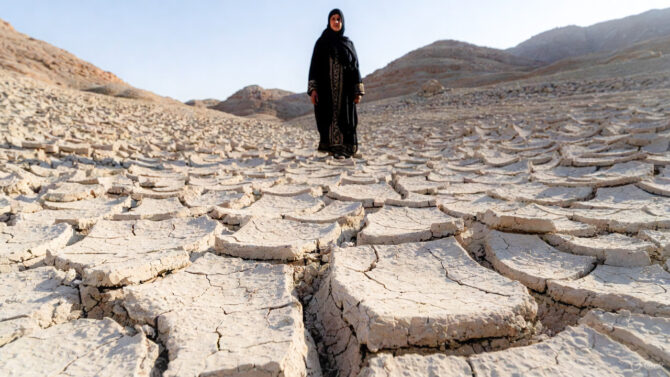
In the past few days, as many environmental advocates have gathered in Belém, Brazil, for COP30, the world’s media has focused, elsewhere, on the unfolding catastrophe in Iran, where one truth has become unavoidable: potable water, not carbon, may be the most immediate environmental emergency of our time. The term now dominating headlines is “water bankruptcy,” and the phenomenon unfolding in Tehran is becoming a case study in what happens when water mismanagement, geopolitics, and climate converge.
Tehran Nears “Water Bankruptcy”
The world has watched Tehran, a metropolis of roughly 10 million people, begin to ration potable water as decades of mismanagement collide with the worst drought Iran has seen in sixty years. Reservoirs that once held the capital’s lifeblood are now running on empty. Rainfall has fallen to historic lows.
Iranian President Masud Pezeshkian recently warned that continued drought could force the evacuation of parts of Tehran, even raising the once unthinkable prospect of moving the nation’s capital. It is difficult to overstate the gravity of such a statement, yet experts say even that does not capture the full extent of the crisis.
Kaveh Madani, director of the United Nations University Institute for Water, Environment, and Health, and former deputy head of Iran’s Department of Environment, has been unsparing:
“The level of their warnings is too low compared to the reality on the ground.”
Madani emphasizes what many in the post Covid era understand too well: governments hesitate to issue the direst warnings for fear of inciting panic, even when the situation demands nothing less.
What Does Water Bankruptcy Mean?
“Water bankruptcy” is not a metaphor. It is a technical condition in which water consumption exceeds water supply, and the deficit becomes irreversible.
This condition is nearly always driven by bad policy decisions,particularly efforts to artificially boost agricultural output in arid regions. Iran’s push for food self sufficiency, understandable in light of decades of sanctions, has resulted in the nation producing 85% of its own food. But the cost has been aquifers and reservoirs drained far beyond sustainable levels.
Today:
- Tehran’s five main reservoirs hold only 11% of capacity.
- In Mashhad, a city of 4 million, reservoirs are below 3%.
- Nineteen major dams nationwide have run completely dry.
- More than 20 others are below 5% of capacity.
These numbers are staggering. And yet a concrete, nation scale solution has yet to be presented. Officials continue to downplay the crisis, wary of provoking public unrest or admitting mismanagement.
But water shortages have already repeatedly sparked protests across Iran, including in Khuzestan Province in 2021, where the demonstrations led to fatal crackdowns. And as trust in government declines, public willingness to cooperate with conservation measures, a critical component of emergency response, declines along with it.
Beyond Tehran: The Kabul Emergency That the World Barely Sees
While Tehran dominates global coverage, Kabul, Afghanistan, may be facing an even more imminent water collapse, but the world barely hears a whisper, in part because the Taliban government provides little transparency and there is no free press.
The facts that do sneak out are alarming:
- Kabul’s aquifer levels have fallen up to 30 meters in a decade.
- Annual groundwater extraction exceeds natural recharge by 44 million cubic meters.
- Nearly half of all boreholes are already dry.
- As many as 120,000 private borewells are draining the aquifer.
- Up to 80% of groundwater is contaminated with sewage and chemical waste.
- Schools and healthcare facilities are closing for a lack of clean water.
- Water prices have soared beyond affordability for many families.
If current trends continue, Kabul may become the first modern city of its size to run out of water entirely. This is not theoretical. It is happening now.
An International Crisis: Water Bankruptcy Goes Global
Iran and Afghanistan are not outliers; they are warnings.
The World Resources Institute has identified 17 countries as facing “extremely high water stress,” defined as consuming more than 80% of available water annually. India, though 13th on the list, has a population more than three times the size of the other 16 countries combined. Cities like Chennai already teeter on the brink.
A quarter of the world’s population lives a few dry weeks away from disaster.
Water scarcity does not respect political boundaries. Where it emerges, it destabilizes:
- Food production
- Energy generation
- Public health
- Regional security
- Mass migration to cities and other countries
A drought was the tipping point with the resultant civil unrest in 2011 that destabilized the Syrian government. As we see in Iran, it can even threaten the physical viability of national capitals cities.
What About the United States?
While the U.S. is not yet Tehran or Kabul, it is a mistake, an increasingly dangerous one, to assume American water infrastructure is immune.
Cities across the United States face profound water challenges:
- San Antonio, reliant on the porous fractured limestone Edwards Aquifer vulnerable to contamination and fluctuating water levels
- Phoenix and Las Vegas, dependent on the drought impacted rapidly declining Colorado River, including diminishing Lake Meade
- Miami, where saltwater intrusion threatens increasingly overtaxed groundwater supplies
- Communities throughout the Great Plains are watching the Ogallala Aquifer drop to levels that will permanently end irrigated agriculture in some regions
- Baltimore, with contamination in infrastructure, includes disinfection byproducts and E. coli, and water conservation challenges due to low legacy reservoir levels
The U.S. does Not face water bankruptcy today, but it is accruing debt.
Conclusion: A Call to Refocus Environmental Priority
This week, many environmental advocates are gathered in Belém, Brazil, for COP30, where climate change takes center stage. But the unfolding crises in Tehran, Kabul, Chennai, and even parts of the United States demand a recalibration of global environmental priorities.
Access to clean, safe drinking water is not a distant threat. It is a present tense emergency affecting billions.
Matters of climate remain critical, but it is a long arc. Potable water is the immediate curve at our feet.
Water is the foundational resource on which human survival, economic stability, and geopolitical security rest. We can transition energy systems over decades. We cannot transition away from water.
The era of water bankruptcy has arrived. The question is whether policymakers and businesses will recognize the urgency and act before more cities find themselves where Tehran stands today.
_________________________
Join us for the next in our webinar series at the Intersection of Business, Science, and Law, “Mandatory GHG Disclosures in Real Estate Contracts” on Tues, Dec 16 at 9 am. The webinar is complimentary, but you must register here.